Mural District photo walk

This slideshow requires JavaScript.

On the morning of Feb. 10, 2012, I went on a self-assigned photo walk in the Mural District in downtown Fresno. I collaborated again with my friend Joseph Edgecomb, who previously went on a photo walk with me at the Big Fresno Flea Market last summer. It was my first photo walk of the new year, and I wanted to try out a bunch of new camera skills that I’ve been practicing in my photo classes at Fresno City College.

This was the first photo walk I’ve taken with my new hand-me-down Nikon D50 digital SLR camera. I used a Nikkor AF-S 35mm f/1.8 prime lens. For the first time, I made all of my exposures using manual settings. I did a lot of bracketing of exposures while in the field, and I tried different exposure combinations on each composition. Also for the first time, I shot the photos in a raw format rather than in JPEG to allow for maximum quality. That allowed me to practice some of my new editing techniques in Photoshop, including the fixing of blemishes with the clone stamp, spot healing brush, and dodge/burn tools, as well as making basic color adjustments.

I loved walking around the Mural District. There is so much new development going on down there, driven by the Assemi family and GV Urban among others. There is also an amazing juxtaposition of new and old throughout the entire area, as renovations pop up alongside, inside, and outside of what has been there before. It’s easy to spot the murals, of course, but it’s also fun to think about what already exists on the streets as a kind of urban art, too. After a while, the mural art and the non-mural art seem to form this seamless mix of visual inspiration.

Check out Joseph’s excellent gallery to compare and contrast with mine.

Radio story: The wonder of Wool Growers

The Wool Growers restaurant and hotel has fed and comforted weary travelers for more than a century.


I’ve lived most of my life in the Central Valley, and I’ve made more trips to the San Francisco Bay Area than I can count. From Fresno, I’ve often driven west on Highway 152 through Los Banos to get there. So when I think about Los Banos, a town of about 35,000 people in southwestern Merced County, my knowledge is mostly limited to a brief drive down the 152 strip. I know which Chevron has the cleanest bathrooms and which local diner has the cheapest two-egg breakfast plate, but that’s about it.

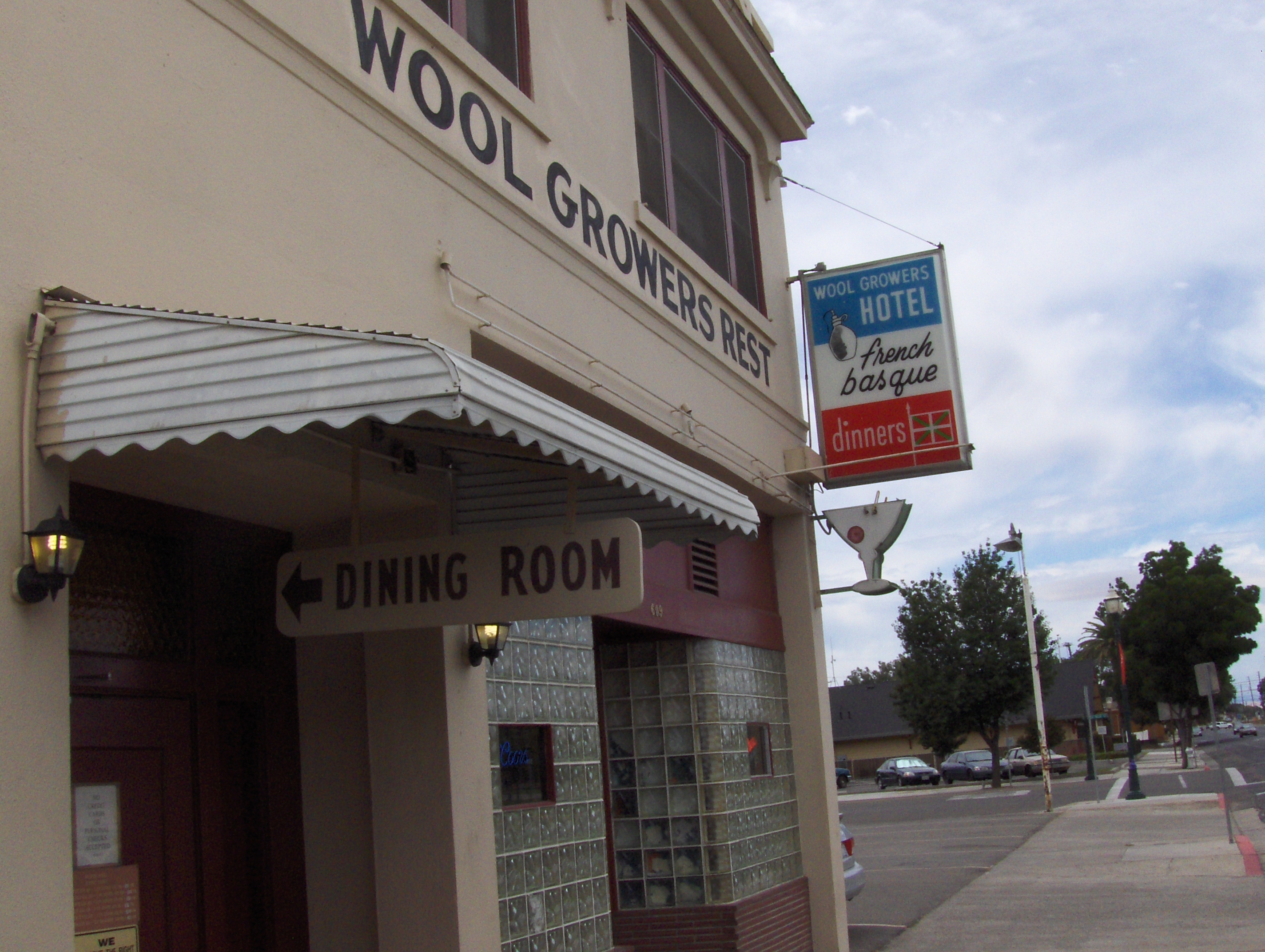
This past summer, while working as an intern for KQED Public Radio, I got to see a little piece of Los Banos that I never knew existed. As part of The California Report magazine’s “hidden gems” themed show for the Fourth of July weekend, I visited the historic Wool Growers Restaurant, where they’ve served family style French Basque cuisine since the 1890s. The restaurant draws locals from all over the west side of the Valley, including tiny farm towns like Dos Palos, Firebaugh, Gustine, and Crow’s Landing. It also attracts many curious travelers and some celebrities. (Multiple people told us about how much NFL commentator and coaching great John Madden just loves the place.)

Wool Growers, on the corner of 7th and H streets.

My colleague, Central Valley bureau chief Sasha Khokha, came up with the idea for the radio feature. She had always heard about the food at Wool Growers and wanted to try it, so when the hidden gems show came along it was a perfect fit. It was about five weeks into my ten-week internship, so we decided that I would take the lead on the sound gathering and interviewing, and Sasha would also record some sound as a backup. Also, since I was an intern, I couldn’t voice the piece on the air myself, so we decided that Sasha would be a character in the story that narrated the experience while we were eating and working. I was nervous throughout the reporting process, but the assignment turned out to be a natural choice for a novice like me.

From the moment Sasha and I walked in, we were surrounded by great sound and colorful characters. I interviewed our waitress, who was one of the owners; a traveler who was there for the first time; a traveler who comes back every time he comes through town; a local father and son who take an afternoon off from their farm work once a month to treat each other to a feast for lunch; and of course, Sasha. She interviewed a second waitress, who was related to the owners, and two groups of locals who also frequent the place. I had no shortage of great material to choose from when putting together my final script.

Here’s the link to the final radio story, voiced by Sasha. With the piece, I earned my very first credits for writing and producing a radio story. I also stuffed my face with a TON of Basque food.

Chinatown photo walk

This slideshow requires JavaScript.

The summer of 2011 marked a newly productive era for me in generating multimedia content. As I began the transition away from being a community college writing instructor to being a freelance radio reporter and student photographer, I produced a series of photo walk self-assignments to get into the spirit. In the past six months or so, I’ve done photo walks on the Fulton Mall, at the Big Fresno Flea Market, in search of aliens via bumperstickers, at the Fresno Urban Sound Experience festival, and at the Big Fresno Fair. These photo walks have made for good starter content here on the blog, but they have also re-energized my interest in photographing Fresno.

I went on my first self-assigned photo walk in Fresno’s historic Chinatown on Friday, July 17, 2011. My good friend and colleague Kelley Campos McCoy joined me. I didn’t quite have my website set up yet, so at the time I posted the results to Facebook. With this post, I’ve finally made the time to transfer over the results. I decided to re-post here all 65 photos that I first chose, to preserve the original edit of the shoot. I’ve since learned, of course, that fewer is almost always better. The captions are lightly edited from the originals, mostly for length.

The photo walk was my first with a cobbled together digital SLR outfit, a completely borrowed kit of random parts. Thanks to the generosity of friends and collaborators Adam Marler and Sasha Khokha, I shot Fresno’s Chinatown with a Canon EOS Rebel XT and an EF-S 18-55mm f/3.5-5.6 lens. Most of the photos were made with auto settings, with the flashed turned off. The photos appear here mostly unedited.

Several memorable moments came out of this photo walk. First, I met Agustín Pérez outside the Buddhist temple, eating a pork burrito that he’d bought at the nearby Chris Meat Market. Agustín seemed lonely and eager to talk. We muddled through in his broken English and my broken Spanish. Agustín asked me to take some photos of him outside the temple and send it to his father and mother in Guatemala. He also asked me to send them ten dollars. I wrote down his family’s address and agreed to do it. My letter to Guatemala may or may not have made it to its destination. I’ll probably never know.

Also, at several points during the walk, people stopped to chat with Kelley and me about what they remembered in the neighborhood. Near the Chinatown Youth Center, an old woman parked in a nearby pickup saw me taking pictures while she was waiting for her daughter at the bank. She shouted from her window to say that the CYC building used to be a movie theater, and she remembered going there as a kid. Kelley also remembered the movie theater, and she said the restaurant next door used to belong to her Filipino grandparents. Kelley said while she was inside the restaurant, which is now a Mexican joint, she tried to make a few photographs but her camera kept jamming and would not work. As soon as she got outside, her camera worked fine. We both chalked it up to the spirits that were clearly still alive in the neighborhood, radiating from every person, every building, and every crack in the sidewalk.

Radio story: China Alley preservation

This slideshow requires JavaScript.

So many little pockets of history exist here in the central San Joaquin Valley. The longer I live here, the more I realize that our collective social history lives and breathes all around us if we tune into it.

This past summer, I helped work on a story about Hanford’s historic China Alley with KQED Public Radio’s Central Valley bureau chief Sasha Khokha, who was given one day to report and produce the feature for The California Report. The trip marked the second time that I went into the field with Sasha during my summer internship. It was still early in the internship — only the third week — so I was still a newbie when it came to sound gathering. Sasha took the lead on the main interviewing and sound work, but she asked me to make photographs throughout the trip and to conduct one interview while she was on a tour. The gallery here features my outtakes.

I interviewed Elaine Stiles of the National Trust for Historic Preservation, which designated China Alley as one of the 11 most endangered historical sites in the country. I only had about five minutes with Ms. Stiles at the end of the dedication ceremony, so I had to make my time with her count. I basically asked her two questions: What was China Alley’s greater importance to the people of California? And: What was her own experience like touring the alley’s deteriorating treasures?

Her answer to the first question made it into Sasha’s story. Her answer to the second question didn’t make it past the cutting room floor, but it stuck in my memory. Stiles, who also is a Ph.D. candidate in history education at UC Berkeley, talked about how fortunate she felt to see for herself such an important part of California history, a now-abandoned ethnic neighborhood where Chinese immigrants once found refuge from inequality by making their own small cultural space. She reminded me that when people’s stories are involved, a building is much more than just a building. And once those physical spaces become endangered, so do the stories.

Here’s the link to the final radio story, written and voiced by Sasha Khokha. Here’s another link to a similar story and photo gallery about Hanford’s China Alley from our colleague Joe Moore at Valley Public Radio.

Radio story: Volunteer guitar teacher

This slideshow requires JavaScript.

My third radio story for The California Report aired on Friday, Dec. 16. I produced a “sound postcard” about 18-year-old Visalia musician Evan Hatfield, who has volunteered his time and energy the past two summers to teach free guitar lessons to kids at the Boys and Girls Club of Tulare County. The classes are organized by Visalia concert promoter Aaron Gomes and his excellent nonprofit Sound N Vision Foundation.

I reported the story this past July during my summer internship at KQED Public Radio, working out the Central Valley bureau office in Fresno. Producing a sound postcard is one of two major projects that interns are asked to complete. The sound postcard is different from a regular feature in that the reporter does not narrate the piece. Instead, the subjects themselves narrate, or the sound itself propels the narrative forward. I had a little bit of both in the final piece.

It’s quite difficult to make a good sound postcard, one that flows organically with the subjects from scene to scene– especially on your first try. I had to travel down to Visalia twice to visit Evan’s class and interview him, because I knew that I needed him to comment on certain ideas in his narration to make the story structure work. I also knew that I needed to get clearer examples of Evan interacting with his students. It was tough to capture the scenes for the story because a guitar class is pretty chaotic by nature, with people continually plunking and strumming. During the sound gathering, I constantly switched back and forth between the warmer room mic (the ElectroVoice RE-50B) and the shotgun mic (the AudioTechnica 8035b).

In the end, I was happy with how the mixing turned out. It was fun to hear Evan describe the class in his own words, hear him interact several times with his students, and also to hear a student and parent describe his classroom demeanor and work. Part of the glue that held the piece together was Evan playing one of his own original compositions at both the beginning and the end. I think the two-minute piece managed to capture multiple elements of what was going on in a very busy class, which was part of my goal.

Looking back on the summer, I was so lucky to work with bureau chief Sasha Khokha, an award-winning radio reporter and documentary filmmaker. Sasha exposed me to a ton of different tasks and assignments in my ten short weeks with her, setting me up in a very short period of time to become a freelance producer for The California Report. I’m grateful for her feedback on this story especially, as she painstakingly walked me through the writing, editing, and mixing process.

Here’s the link to the final radio story. Also, please consider donating to Sound N Vision, to help them keep their summer educational programs free and accessible.