For our second assignment in my GRC 41 class, the instructor asked us to develop a set of “holiday web icons” using the shape tools and lines tools in Adobe Illustrator CS4. The tools used included: square, rounded rectangle, ellipse, polygon, star, flare, line, arch, spiral, rectangular grid, and polar grid. We had to make 55 icons total, on one 8.5 by 11 inch artboard. He asked us to start with the basic main tool shape and then add elements, gradients, colors, line strokes, shadows, etc. We could focus on any one holiday or season. I chose summertime.
I have used Illustrator very little in the past, so the program is basically completely new to me. These icons are pretty simple due to my limited Illustrator skills. But also, web icons are meant to be simple, because they appear very small on a website within text. I do hope to revise this assignment for the final portfolio. But for about 10 hours of work and some light reading in my Illustrator quickstart guide, I’m pretty happy with it.
For our first assignment in my GRC 41 class, the instructor asked us to create an expressive word for each of 10 words. No images, no color. Black and white only. And as an added challenge: We could only use the Helvetica family of fonts, with any weight or variation within the typeface. We designed the words on 10 different 8.5 by 11 inch artboards, so we were encouraged to think big. I saw the assignment as “talking through fonts,” and I thought it was a great way to get the class started on the first night.
I’ve always loved fonts, so I particularly enjoyed this assignment. It reminded me of when I first started designing, as a typesetter at the old Fresno Bee Neighbors publications in 1994-95. We literally had only a dozen fonts, and the advertising reps were always pushing us to deliver “something different.” That was a great crash course for me in stretching my font use, and this assignment plugged me back into that time.
Footnote: Check out this Helvetica blog for some laughs.
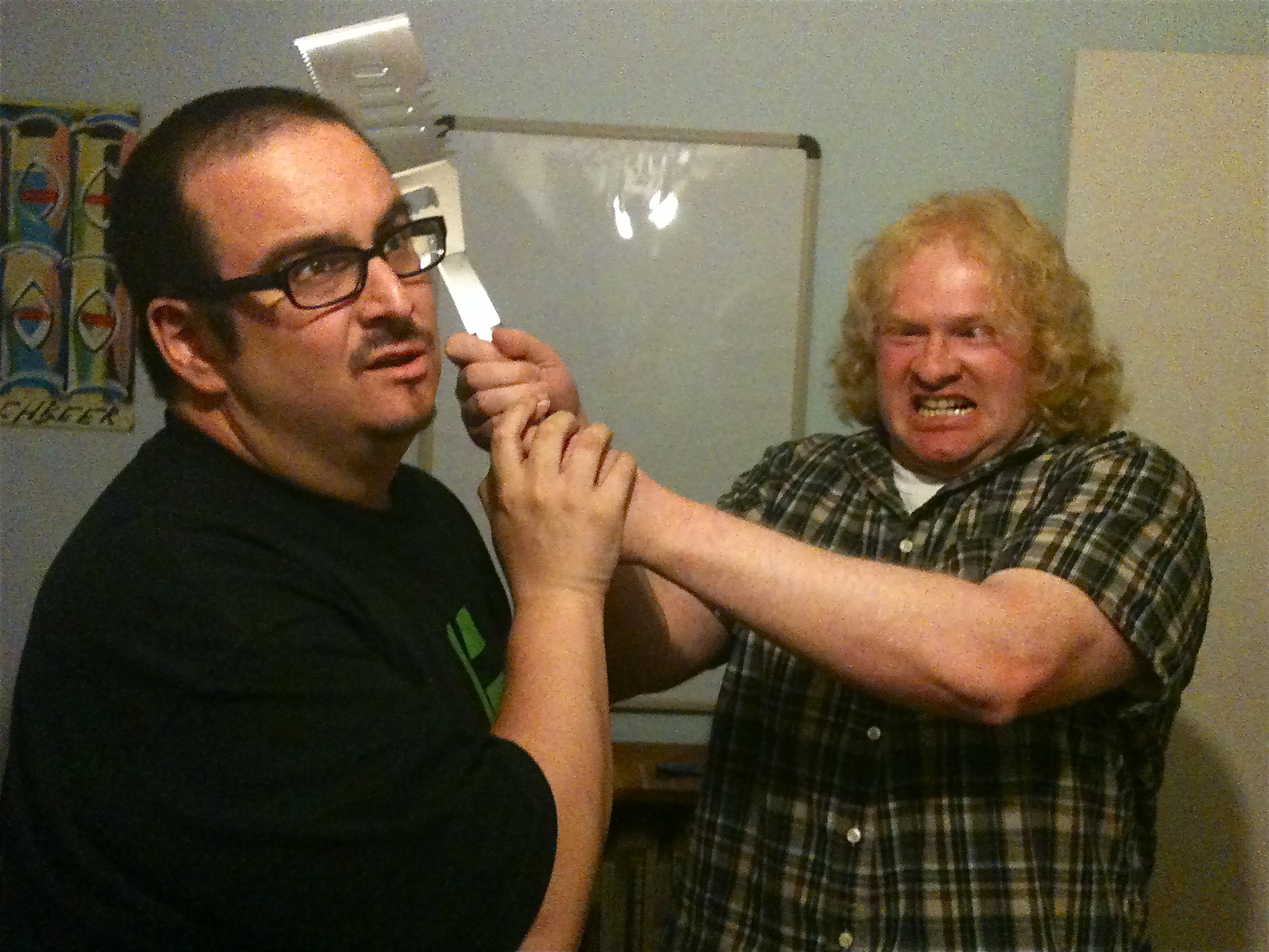
Photo by my wife, starring me as Werner Herzog and Reaz Mahmood as Klaus Kinski.
I will long remember the summer of 2011 as my Summer of Herzog.
Herzog and Kinski during the filming of "Cobra Verde."
I first became aware of German filmmaking genius Werner Herzog more than 20 years ago, when I was a teenager. I am a longtime fan of the British post-punk band Joy Division, and as any true follower of the band knows, Herzog’s inscrutable cinematic ballad “Stroszek” was the last movie that Joy Division signer Ian Curtis watched on the night he committed suicide in May 1980. I have watched “Stroszek” three times and have yet to understand it. I will probably never understand it. Cultural critics have long tried to dissect the connection between the death of the protagonist in “Stroszek” and the death of Curtis, but I believe that any speculation on the reasons for any person’s suicide is ultimately conjecture, an invasion of privacy that can yield no clear answers.
For me, Herzog’s work also yields no clear answers, a similarity that I think cuts to the heart of filmmaking, art making, and meaning making of any kind.
Earlier this summer, I drove up to Modesto with my wife Tracy and our good friends Reaz Mahmood and Susan Currie Sivek to see Herzog’s latest documentary, “Cave of Forgotten Dreams.” It was a strange and wonderful little picture, uncomfortable to watch at times and filled with Herzog’s classic wonder and philosophy. Like all the documentaries Herzog has made in the last decade, it made you giggle at the audacity of the filmmaker’s questions about people’s dreams, but it also somehow made you giggle at yourself for living, right here, right now, in this absurd moment. You wondered: Why haven’t I asked the same questions Herzog is asking? What are my days worth? My own dreams?
Kinski and his phonograph in "Fitzcarraldo."
On a recommendation from my good friend Kurt Hegre, Reaz and I checked out two of Herzog’s most critically acclaimed films, “Aguirre, Wrath of God” and “Fitzcarraldo.” Both of us were stunned at the staggering filmmaking of Herzog and the maniacal acting of Klaus Kinski in each. These two films then led us to two documentaries about Herzog and Kinski, “Burden of Dreams” and “My Best Fiend,” which each give candid context to the volatile relationship between two geniuses, as well as deeper insights into the impulses that drive Herzog to make the kinds of impossible movies that he makes. Check out this YouTube clip from “Burden of Dreams,” in which Herzog riffs on the obscenities of the jungle:
The thing that I admire about Herzog is his uncompromising quest to understand himself and the nature of dreams. Reaz and I have talked a lot about how Herzog’s extremes as a filmmaker–his insistence on plunging himself and his crew into life-threatening scenarios in order to get a more “real” representation of their experience on film–are, on one hand, admirable. But on the other hand, I think we agree that every person who makes art of any kind has to establish that boundary for him or herself. An amazingly funny and accurate web series spoofs Herzog’s beyond-intense immersion tactics. (Hours of fun!) But for me, Herzog’s point is made: Don’t make art unless you are willing to sacrifice for it, unless you are willing to answer the very biggest questions, unless you are willing to spend your whole life trying to understand your dreams. If you don’t strive for meaning, as Herzog says, “We only sound and look like badly pronounced and half finished sentences out of a stupid suburban novel, a cheap novel.”
On the morning of Saturday, Aug. 13, I went on a self-assigned photo walk at the Big Fresno Flea Market and Swap Meet at the county fairground in southeast Fresno. My friend and former student, Joseph Edgecomb, came with. After my last photo walk on Fulton Mall, I wanted to go to a place this time where I would have to make photographs of people. The more journalists and artists I talk with, the more I realize that just about everybody has a hard time walking up to strangers in these contexts, so I’m working on getting better.
Joseph and I were challenged right away by the flea market’s assistant manager, who told us that photography was not allowed without the consent of each individual vendor first. After several exchanges with him, and after several vendors said no when I asked if I could make pictures of them and/or their stuff, I got discouraged. But Joseph gave me a little pep talk, and after a while it did get a little easier. About half of my photos from the full shoot had people in them, which I was quite happy with. Most of all, I got to meet a lot of interesting characters.
This was my third photo walk with my borrowed digital camera outfit of random parts. I shot the flea market on color digital with a Canon EOS Rebel XT and an EF-S 18-55mm f/3.5-5.6 lens. Most of these photos were shot with auto settings, with the flash turned off. The photos appear here lightly edited with “color boost” in iPhoto, also with some modest crops and adjustments for shadows. You can check out Joseph’s excellent gallery to compare and contrast. Again, two people in the same place saw the scene a lot differently, which always surprises me.
On July 15, I went on a photo walk in Fresno’s historic Chinatown with my friend and colleague Kelley Campos McCoy, who teaches journalism at Fresno State. It was my first photo walk, and I posted the photos to my Facebook profile. I’ll work on getting a slideshow put up here on the website sometime this week, so my non-Facebook readers can see the results.
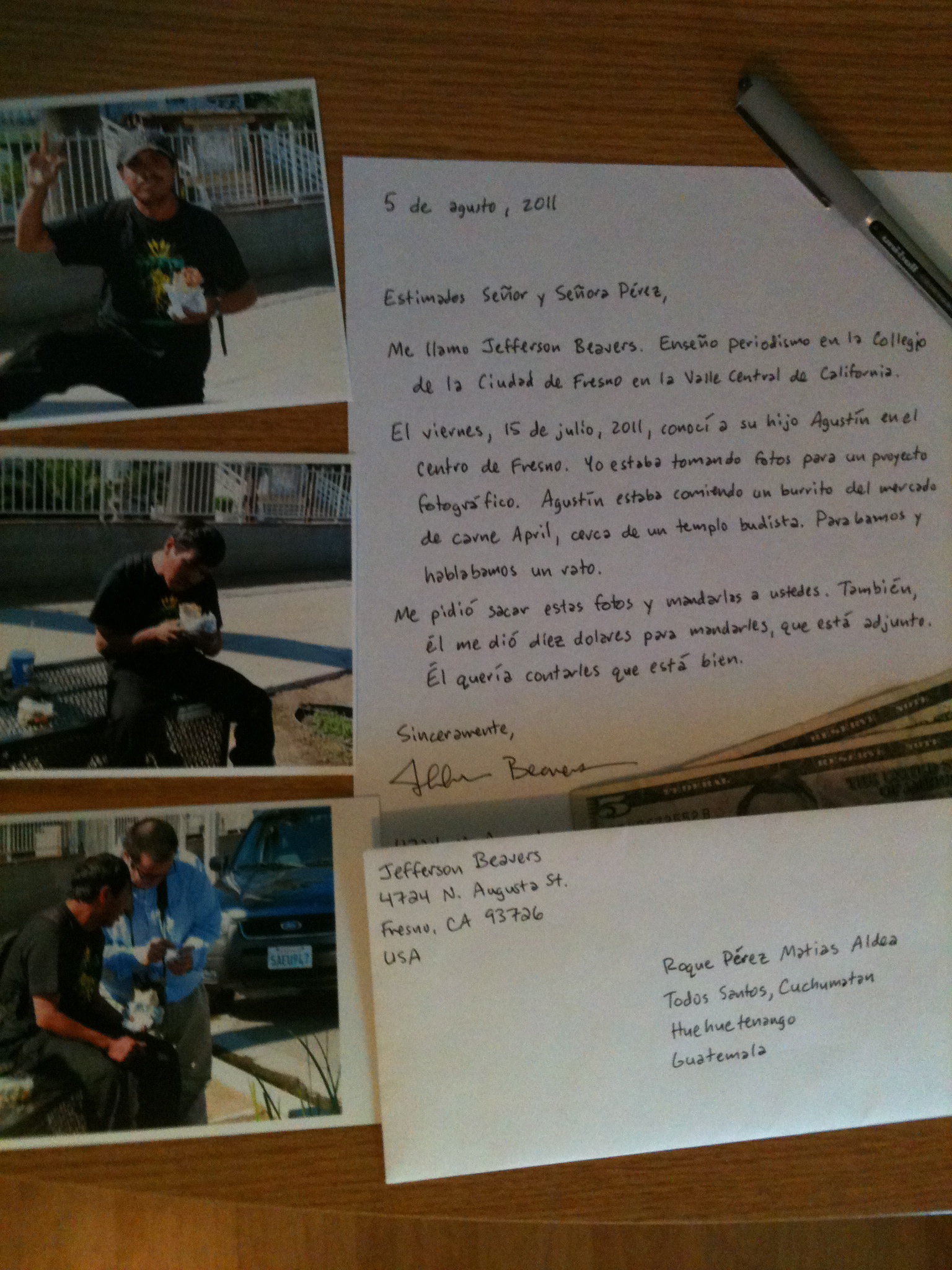
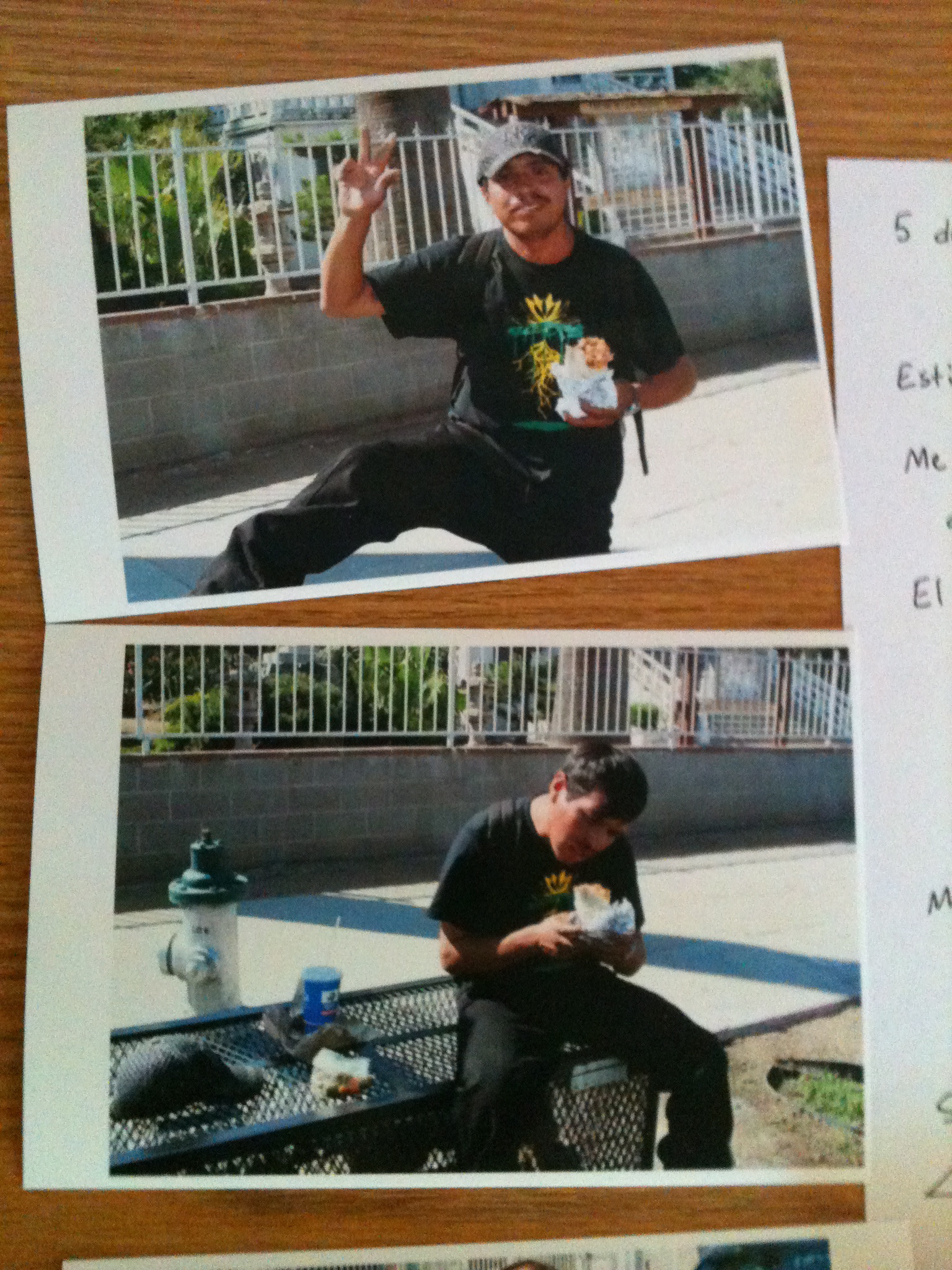
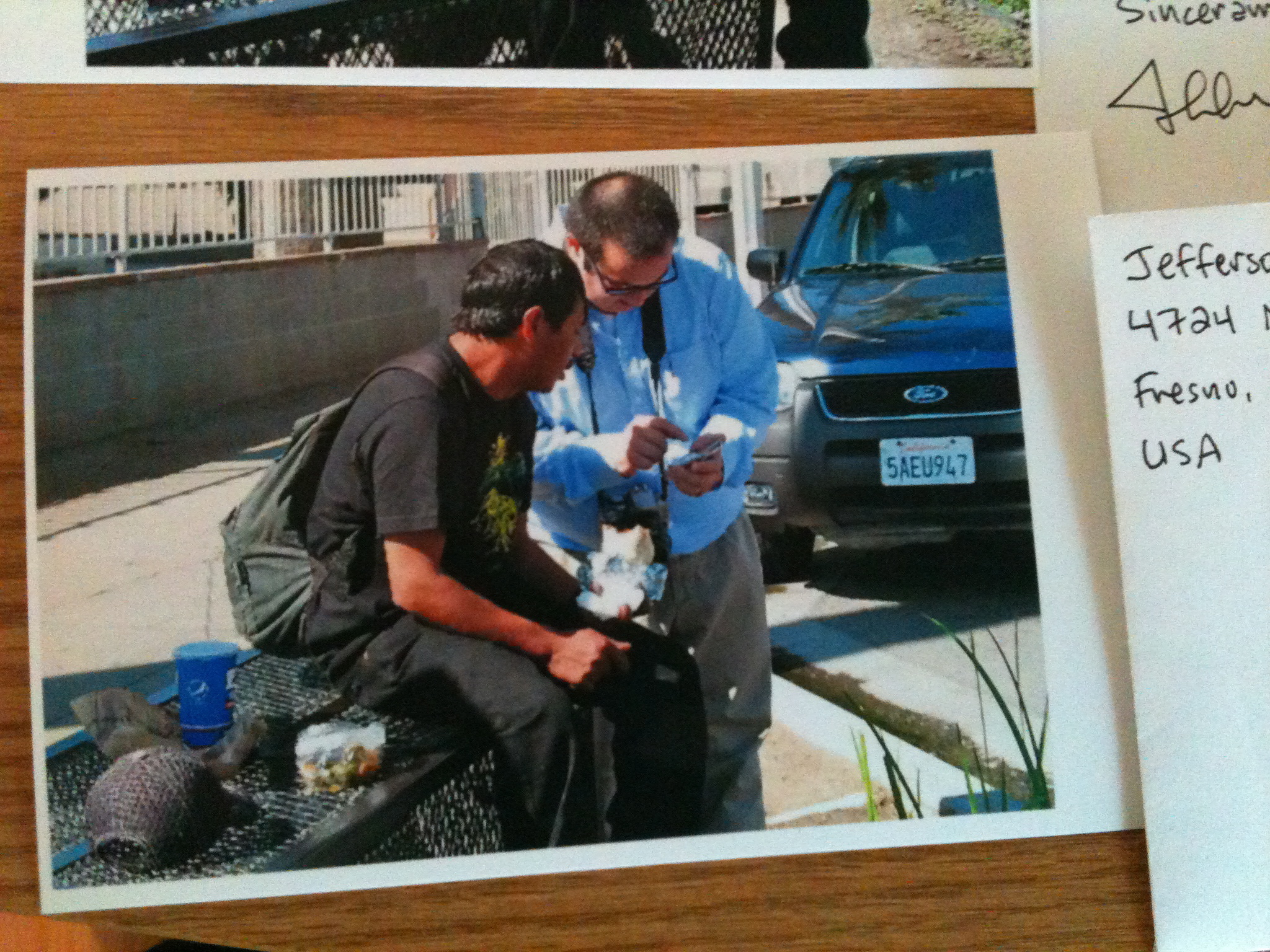
Early in the walk, I met a young man named Agustín Pérez outside the Buddhist temple. He was eating a pork burrito that he’d bought at April Meat Market across the street. Agustín seemed lonely and he was eager to talk. We muddled through a conversation in his broken English and my broken Spanish. Agustín said he had been working in the fields but that he had the day off. He said he had no address or phone number for me to contact him. Agustín asked me to take a photo of him outside the temple and a photo of him eating and send them to his father and mother in Guatemala. He also asked me to send them ten dollars. I wrote down his family’s address and agreed to do it.
It took a little while for me to take note of the correct address details for Agustín’s parents. I wanted to make sure and get it right. The address Agustín gave me did not have any house numbers or postal codes. He said that was accurate. The letter will simply be addressed to his father, Roque Pérez Matias Aldea, in the city of Todos Santos, Cuchumatán, in the Huehuetenango province of Guatemala. Kelley took a photo of the two of us talking, as I diligently entered notes on Agustín’s address into my iPhone.
I did some research on Agustín’s hometown by Googling parts of his address. I found an informational website put together by Professor Robert Sitler of Stetson University in Florida. The site details the basics of language and culture in the mountainous municipality of Todos Santos in northwestern Guatemala. I then asked my good friend Rebecca Plevin, who writes about health and environmental issues in the Latino community for Vida en el valle newspaper, to help translate my short letter to Agustín’s parents. As Rebecca and I checked out Prof. Sitler’s website, we realized that a letter in Spanish might not work for a community that mostly speaks Mam, a Mayan dialect! But it was the best we could do. Here is my original letter, in English.
Dear Mr. and Mrs. Pérez,
My name is Jefferson Beavers. I teach journalism at Fresno City College in central California. On Friday, July 15, 2011, I met your son Agustín in downtown Fresno. I was taking pictures for a photography project. Agustín was eating a burrito from April Meat Market, near the Buddhist temple. We stopped and talked for a while. He asked me to take these photos and send them to you. He also gave me ten dollars to send to you, which is enclosed. He wanted me to tell you that he was doing well.
Sincerely,
Jefferson Beavers
Although it has taken me several weeks to pull together all the pieces — writing the letter, getting the translation, and printing out the photos — I am going this morning to the post office to send the letter. I do feel bad that it has taken me a little while, because as I’ve thought about my short meeting with Agustín, I realize that his request of me was actually quite urgent and important. He wanted to let his parents know that he was alive, happy, and eating well. He also wanted to send them what money he could in that moment. I’m sending this letter to Mr. and Mrs. Pérez with great faith that it will reach them, and I hope their son is still doing OK.



 Jefferson Beavers