
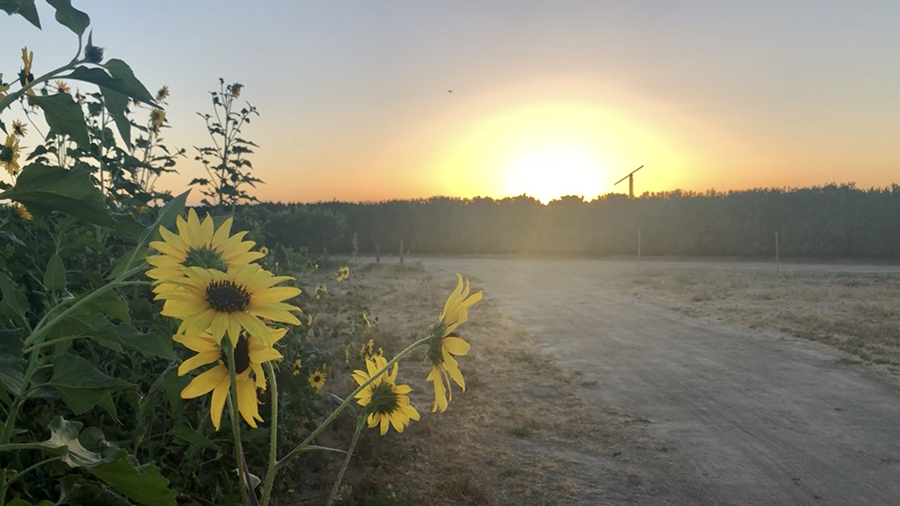
“I want to always sleep inside a golden sunrise”
I asked a poet friend recently– semi jokingly and semi seriously– if it was allowable to write a poem after Terrance Hayes, who wrote a poem after Federico García Lorca, when I haven’t studied the poetry of either writer very deeply. Being supportive, my poet friend replied: “It’s poetry; do what you need.”
This advice could apply to any kind of art making, I think. Do what you need. My poet friend went on to say– semi jokingly and semi seriously– that he’s proudly from the “School of Discombobulated Poetics,” a membership that presumably gives him a bit of *ahem* poetic license to mix and match whatever material is around him to create an idea he can call his own. As a practicing junior member of this School, I’m going to go ahead and borrow my poet friend’s idea as the genesis for this blog post.
For the third creative quest in my yearlong artmaking fellowship with the Masumoto family, I decided to try making something I’d never tried before: a sort of multimedia tone poem about the farm. I’ve long enjoyed the cinematic scope of American independent filmmaker Terrence Malick, in particular his films The Tree of Life and To the Wonder. I wanted to see if I could imitate his sweeping visual and non-narrative style, to push myself in both my rudimentary poetic skills and in my rudimentary video editing skills. I wanted to make a short film about the farm that felt like the farm but didn’t need a “story” to inspire this feeling. Here’s the result:
I started out by thinking about basic shot sequences in movies– wide, medium, and close-up. I could never make a movie as grand as Malick, especially considering the equipment it would take to make his signature panoramic wide shots and the gorgeous orchestral music he has composed by professional musicians, to stitch together unrelated images and scenes across time. But I knew that I am a pretty good shooter, due to my experience with photography, so I wanted to practice basics– wide, medium, and close-up. I would stitch the footage together later with some kind of voiceover, maybe some lines from a Masumoto essay, or maybe an original poem I would write.
After spending a morning in early June on the farm, starting at daybreak, I had a little more than an hour’s worth of footage to work with. I spent a lot of time mentally drafting a possible order, sketching a few visual ideas in a notebook, and then finally sitting down to give the shoot a serious edit and put together some kind of visual order. My first cut was nearly 12 minutes long, my rough cut was just over 7 minutes long, and the final version came in at 4:23. I put my faith in the visuals, much as Malick does, to generate some kind of “story” that was outside of a narrative with a beginning, middle, and end. I’m pleased with the result, a snapshot of a morning on the Masumoto farm.
This brings me back to my poet friend, and to Hayes and to Lorca.
Watching my 7 minute rough cut several times, I sketched out key words and phrases and ideas that came to mind. I didn’t want the words to necessarily be synced to the visuals or an “explainer” of the visuals like traditional narration, but I wanted to feel the words were doing their own work, with the visuals side by side.
Perhaps the primary “character” I discovered in the rough cut was the wind. The sound of the wind was always present in every piece, often challenging me to deal with its power and unpredictability in the audio editing. I remembered an article I read once about an experimental sound artist and NPR field producer who “interviewed” the wind for a longform feature story. I thought: What if the ingredient I am looking for to stitch these visuals together is actually in a sound? This idea felt right.
This is the moment I did something very 21st century: I googled “famous poems about wind.” One of the first was “Wind in a Box” by Terrance Hayes, a striking and elegant poem he wrote after Lorca. Which led me, of course, to google “Lorca poems about wind,” leading me to the beautiful, forlorn translation of his “Romance sonambulo.” I heard my poet friend in my ear at this point: Take what you need.
From there, I tried to use my own key words and phrases about the wind with the cadence and line breaks of Hayes, to generate my own poem. Here’s that poem in text form, which I find interesting to look at in comparison to how it works inside the short film.
To Box the Wind
After Terrance Hayes
I want to always sleep inside a golden sunrise
on your farm. I want to tune your engine
so it sweeps itself onward and outward,
past the sunflowers, past the unblinking horizon.
I want to outlive daybreak, tune myself
to the silt and the grass. I want to become a shadow
along the edge of your orchard, become the wind
humming through the peach trees, become leaves
neatly folded around each glowing piece of fruit.
I want to march tenderly, forcefully
past the hills the ants made, toward your harvest.
I want to ride through your grove, gilded
on all sides, riding a great big Massey Ferguson
to the very end of each row. Bring your farm dogs;
I want them to meet me. I will sit with them
in the middle of the avenue and we will listen to the wind.
I want to catch this morning’s last band of sunlight,
caught in the wind’s hum, before it’s gone;
after the fruit falls, I want to leave it for the earth.
I want to become the old water pump
working through its rust, moving ditch water forward,
sparkling, electrified, holy, pumping straight to its sump.
I want a brand new moment— a quiet moment
in the packing shed, which lives at the farm’s heart.
I want to learn the wind’s intuition here, but not
its fury. I want to hit the switch of your old AM radio
just to see what it’s like to interrupt this beautiful dream. …
… I know, of course, the discarded fruits from your
organic farm are not really discarded. I know they return
to rest in the very ground they sprang from. I want
to mash them. I want to blow them a final kiss.
I want the wind of your farm to become the calm
at the center of my heart. I want your chimes
to chime like a sound in my memory, a memory
of makeshift altars, for the dead and for the living,
a tiny house where time itself speeds and then slows,
moves on. When I leave your land, I want the wind
to fight its way into each poem, each photograph, each song.
How joyous it felt to take what I needed– from Malick, from Hayes, from Lorca, from the Masumoto family farm, from my poet friend, from myself– to make this short film, my own little wind song for summer.
Previously in this blog series:
• Creative Quest #2: Names of Old Friends
• Creative Quest #1: Beauty in the Central Valley
• A Conversation with Nikiko Masumoto
 Jefferson Beavers