Radio story: China Alley preservation

This slideshow requires JavaScript.

So many little pockets of history exist here in the central San Joaquin Valley. The longer I live here, the more I realize that our collective social history lives and breathes all around us if we tune into it.

This past summer, I helped work on a story about Hanford’s historic China Alley with KQED Public Radio’s Central Valley bureau chief Sasha Khokha, who was given one day to report and produce the feature for The California Report. The trip marked the second time that I went into the field with Sasha during my summer internship. It was still early in the internship — only the third week — so I was still a newbie when it came to sound gathering. Sasha took the lead on the main interviewing and sound work, but she asked me to make photographs throughout the trip and to conduct one interview while she was on a tour. The gallery here features my outtakes.

I interviewed Elaine Stiles of the National Trust for Historic Preservation, which designated China Alley as one of the 11 most endangered historical sites in the country. I only had about five minutes with Ms. Stiles at the end of the dedication ceremony, so I had to make my time with her count. I basically asked her two questions: What was China Alley’s greater importance to the people of California? And: What was her own experience like touring the alley’s deteriorating treasures?

Her answer to the first question made it into Sasha’s story. Her answer to the second question didn’t make it past the cutting room floor, but it stuck in my memory. Stiles, who also is a Ph.D. candidate in history education at UC Berkeley, talked about how fortunate she felt to see for herself such an important part of California history, a now-abandoned ethnic neighborhood where Chinese immigrants once found refuge from inequality by making their own small cultural space. She reminded me that when people’s stories are involved, a building is much more than just a building. And once those physical spaces become endangered, so do the stories.

Here’s the link to the final radio story, written and voiced by Sasha Khokha. Here’s another link to a similar story and photo gallery about Hanford’s China Alley from our colleague Joe Moore at Valley Public Radio.

Movie Monday: “Helvetica”

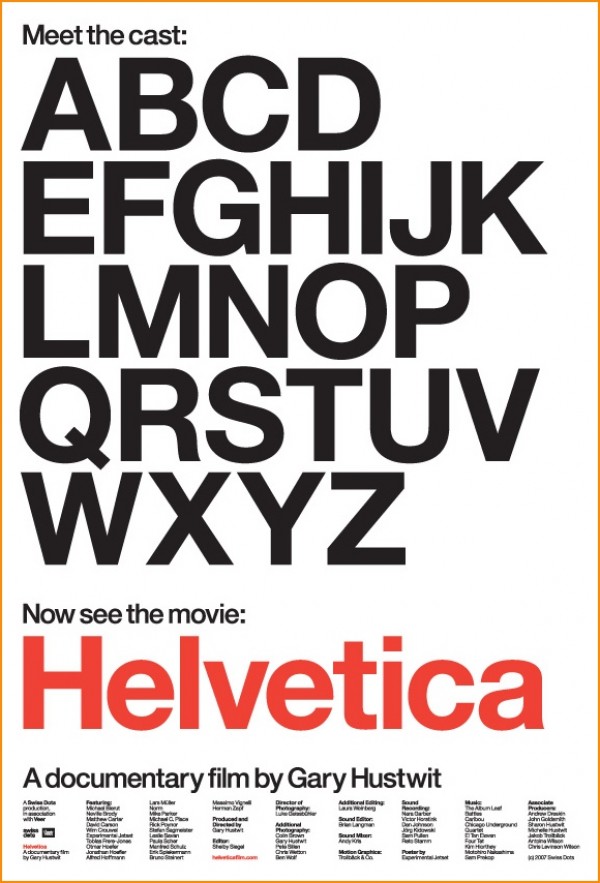
“Helvetica”
Directed by:
Gary Hustwit
Format: DVD from the public library
Viewed: Friday 12/30/2011 with my wife at home

I got my second journalism job while I was still in college. For two years, I produced print advertisements as a graphic designer for The Fresno Bee’s community publications division. I use the term “graphic designer” quite loosely, since it was the mid-’90s and we were using IBM 486s, which featured about a dozen fonts and had just enough power to run PageMaker 2.0 if you shut down all the other programs that you were working in first. The big upside to getting my start in that environment was that all of the ad reps wanted their clients’ ads to look special and different, and so I had to learn very quickly how to use all the basics of design and layout to make a tiny number fonts consistently do the work of a million fancy requests.

The font Helvetica got a real workout.

Helvetica is such a sturdy, efficient, and iconic typeface, and I was happy to get reacquainted with it this past semester on the first assignment for my graphic communication class. My graphics instructor recommended seeing the Gary Hustwit documentary about Helvetica to appreciate the importance of the world’s most ubiquitous family of type. I’m glad that I did. The movie is the first in Hustwit’s design trilogy that looks at the power of typography, design, and urban planning in our daily lives. The director filled the movie with fascinating and eloquent historical dialogue about the font, and some excellent criticism of using design for purposes of control.

My favorite idea in the film came from Wim Crouwel, a Dutch typographer whose work I first came across years ago as part of the Peter Saville-designed sleeve to the Joy Division compilation “Substance.” Crouwel, speaking of his love for Helvetica, said: “The meaning is in the content of the text and not in the typeface.” Thinking back to my days as a beginning designer more than 15 years ago, it seems like I’ve always agreed with him.

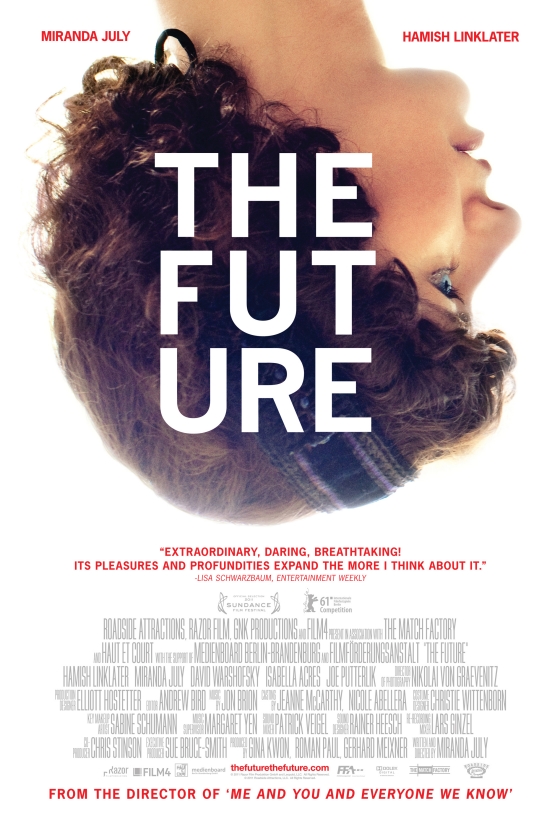
Movie Monday: “The Future”

“The Future”
Directed by:
Miranda July
Format: DVD from Redbox
Viewed: Sunday 12/25/2011 with my wife at home

I loved Miranda July from the first moment I laid eyes on her. Her first movie was strange and wonderful. Her short story collection was obtuse and compelling. Her project website was an artistic challenge to viewers like nothing I had seen before. In short: I will be loyal to this woman no matter what she makes– good, bad, and everything in between.

I did not love “The Future” in the same way that I loved “Me and You and Everyone We Know.” But it took my breath away more than once. It made me cry more than once. And it should come as no surprise that I would recommend the film to anybody who likes Miranda July even just a little bit. Judging by some of the harsh customer reviews on the Redbox rental site, I appear to be in the minority when it comes to liking Miranda July. So be it. This movie is sprawling, surreal, and difficult. It is narrated by a cat. The two protagonists– especially Miranda July herself– are hard to love. None of those things are negatives because the film has a pulsing, beating heart and ugly, glorious guts to match.

Rewind 2011: Best media


Here is my list of favorite media for 2011. In the past, I have made a top movies list, but this year I just didn’t get out to see as many first-run films as I would have liked. So I decided to also include other media in my final list of the year. I hope you find something you enjoy. Please leave some of your favorite media picks in the comments!

1. Event: Swede Fest 8
The world’s only festival for sweded films is right here in little old Fresno. Who knew?! The DumbDrum.com boys have been making better and better movie parodies, and this year they seemed to blow up all over the Internet. I even gathered sound from the latest event for a story on NPR’s Morning Edition. It was my first time attending the festival, and I have to say that I was pleasantly charmed at the communal feeling of watching the homemade swedes together in a room with my fellow movie fans. This was my favorite event of the year, and I’m definitely going back.

2. Movie: “Cave of Forgotten Dreams”
My favorite movie of the year is a documentary by Werner Herzog about cave paintings in Southern France. Yes, you read that correctly – Herzog, cave paintings, France. I had enjoyed Herzog’s films before, but this one, made now in the twilight of his directing life, took on a new meaning. The movie has haunted me all year for the urgency in which Herzog attempts to understand the origins of man as a way to understand himself. Seeing the film sparked an entire Summer of Herzog for me, as I got to know an extraordinary director’s back catalog even better.

3. Online: NPR Music on Facebook
I have always been a casual listener of noncommercial radio, but my internship at KQED Public Radio this past summer really tuned me in to a whole new world. My favorite find has been NPR Music on Facebook, a “radio station” in my social media feed that has exposed me to top-notch programs such as All Songs Considered and World Cafe, and has also led me to explore other music-related NPR and public radio features. For someone like me, working to re-brand himself as a multimedia journalist specializing in arts and culture reporting, NPR Music is now essential.

4. Movie: “Midnight in Paris”
I’m always a sucker for Woody Allen movies – even when they’re bad. For me, even a bad Woody Allen movie is better than ninety percent of what’s playing in the theater on most days. Fortunately, this film is one of his great ones. It is difficult to review the movie without giving away its secrets. So I will just say that Owen Wilson is great as the writer, Corey Stoll is a revelation as Ernest Hemingway, and the city of Paris is terrific as its magical self. Grab your favorite English major friend and get him or her to see this film before midnight.

5. Online: @Dr_Cop on Twitter
My good friend Adam Marler lives multiple lives. He’s a mixed media artist based in Fresno who is perhaps best known for producing 15 long-form interviews on his I Don’t Get It podcast, featuring Fresno creatives talking about making art in the Central Valley. At his day job, Adam works as a pest trapper for the state citrus research board. He enjoyed 15 minutes of fame this past summer for his work tracking the Asian citrus psyllid, a job where he rides around in a pickup truck all week logging insect data while listening to NPR and making obscure social-media art. His Twitter feed offers a daily stream-of-consciousness joyride into his droll, eccentric alter ego “Dr. Cop,” a lovable Internet jester who carries himself at the comical intersection of the absurd and the profound.

6. Movie: “Tree of Life”
I love going to movies where people walk out in the middle of them. I try to imagine what those people are thinking as they flee their seats. Like, “Well gosh, it did have Brad Pitt and Sean Penn in it!” Or maybe, “But the poster looked so cute!” Their loss, really. I won’t pretend to understand everything that Terrence Malick was trying to say or do with this film. I probably never will. But like the best films, there are so many images and ideas from “Tree of Life” that linger still. (Also, check out this beautiful swede by Fresno filmmaker Vince Cosentino.)

7. Online: Harvesting Health blog
Rebecca Plevín gets it. She’s a journalist who understands that telling stories about people is the very best way to tell stories about public policy. She has written about Latinos in the Central Valley since 2008 for Vida en el Valle, the bilingual publication put out by McClatchy. But Plevín has made her biggest impact with Harvesting Health, a blog that celebrated its one-year anniversary this past June. She covers the major health issues in our region – big issues like hunger, obesity, teen pregnancy, air quality, access to clean water, and more. But what makes her different is that she spends time writing about everyday people, and she documents their difficult fights for good health, both private and public. She’s a compelling, straightforward advocate for better health. Plevín’s Twitter feed is also an excellent aggregate source of Central California health news.

8. Movie: “Bill Cunningham New York”
My wife and I watched this film with our artist friends Laura and Zach, who turned their living room into a makeshift movie space for the occasion. It was fitting: Their whimsy for their own space became, for me, an integral part of experiencing the whimsy of the movie. I didn’t care for the filmmaker’s insistence on pushing Cunningham about his understated private life, which to me was irrelevant. But I absolutely loved the portrayal of Cunningham’s natural curiosity and love for photographing people and their fashions for The New York Times. It was a joy and an inspiration to watch such an honest photojournalist at work on the streets.

9. Book: “How Do I Begin? A Hmong American Literary Anthology”
I don’t read a lot of books the year that they come out. I’ve just never been that kind of reader. But I’m grateful in many ways to have found this new collection of Hmong American literature as it debuted to the world. My first freelance story for The California Report featured the book, and I attended two readings where the authors read from their powerful work. I loved re-connecting with Burlee Vang, making a new friend in Soul Choj Vang, and most of all reading these diverse, heartbreaking, and important stories.

10. Movie: “The Future”
I’m a sucker for pretty much anything Miranda July makes, so I knew going in that I would like this movie. It was pretty difficult to like, though, for lots of reasons. I mean for goodness sakes, a stray cat narrates the film, so you know the movie is going to be a challenge. But there are so many little details and scenes that have stuck with me and kept me thinking. Viewed as a movie, “The Future” might not be considered very successful. But viewed as living performance art, I think July has made a brave, messy, vital document of this very moment.
Radio story: Volunteer guitar teacher

This slideshow requires JavaScript.

My third radio story for The California Report aired on Friday, Dec. 16. I produced a “sound postcard” about 18-year-old Visalia musician Evan Hatfield, who has volunteered his time and energy the past two summers to teach free guitar lessons to kids at the Boys and Girls Club of Tulare County. The classes are organized by Visalia concert promoter Aaron Gomes and his excellent nonprofit Sound N Vision Foundation.

I reported the story this past July during my summer internship at KQED Public Radio, working out the Central Valley bureau office in Fresno. Producing a sound postcard is one of two major projects that interns are asked to complete. The sound postcard is different from a regular feature in that the reporter does not narrate the piece. Instead, the subjects themselves narrate, or the sound itself propels the narrative forward. I had a little bit of both in the final piece.

It’s quite difficult to make a good sound postcard, one that flows organically with the subjects from scene to scene– especially on your first try. I had to travel down to Visalia twice to visit Evan’s class and interview him, because I knew that I needed him to comment on certain ideas in his narration to make the story structure work. I also knew that I needed to get clearer examples of Evan interacting with his students. It was tough to capture the scenes for the story because a guitar class is pretty chaotic by nature, with people continually plunking and strumming. During the sound gathering, I constantly switched back and forth between the warmer room mic (the ElectroVoice RE-50B) and the shotgun mic (the AudioTechnica 8035b).

In the end, I was happy with how the mixing turned out. It was fun to hear Evan describe the class in his own words, hear him interact several times with his students, and also to hear a student and parent describe his classroom demeanor and work. Part of the glue that held the piece together was Evan playing one of his own original compositions at both the beginning and the end. I think the two-minute piece managed to capture multiple elements of what was going on in a very busy class, which was part of my goal.

Looking back on the summer, I was so lucky to work with bureau chief Sasha Khokha, an award-winning radio reporter and documentary filmmaker. Sasha exposed me to a ton of different tasks and assignments in my ten short weeks with her, setting me up in a very short period of time to become a freelance producer for The California Report. I’m grateful for her feedback on this story especially, as she painstakingly walked me through the writing, editing, and mixing process.

Here’s the link to the final radio story. Also, please consider donating to Sound N Vision, to help them keep their summer educational programs free and accessible.