Radio story: Cassette tape resurgence

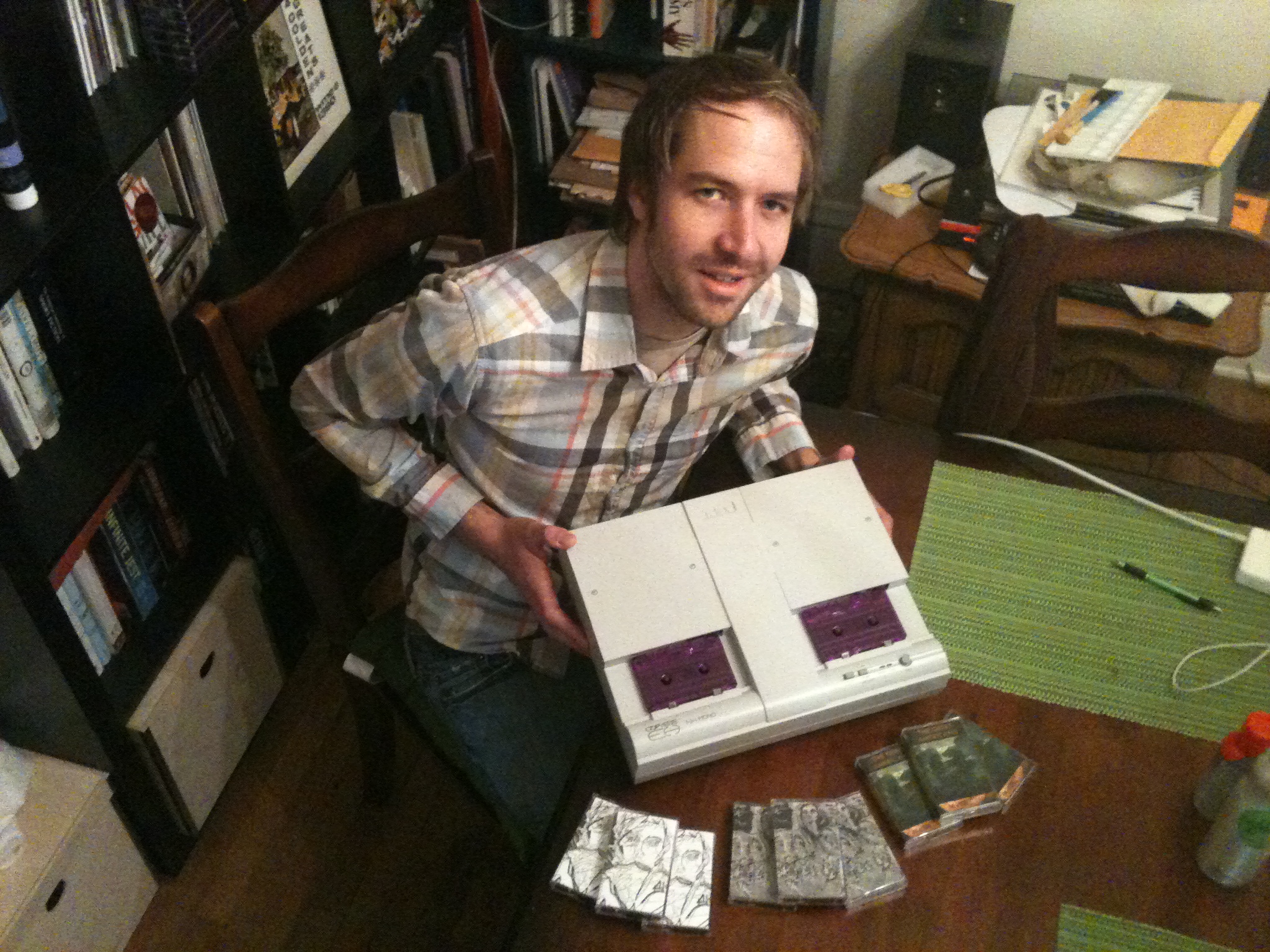
A man and his Telex Copyette: Fresno musician Daniel Schultz of coattrack records.

My second freelance radio story for The California Report aired on Friday, Nov. 25. I reported on the unlikely resurgence of cassette tapes in the indie music scene, and I focused on the Fresno-based coattrack records collective as one example of do-it-yourself musicians coming together to share their work with their fans in a simple, cost-effective way via tapes.

I conducted the primary interview for the story with Daniel Schultz, the drummer for the Fresno band Achievement House and the founder and sole operator of coattrack. I first talked with Daniel way back in November 2010 as part of a FUSE Fest 2010 sampler on my old Evening Eclectic music show on 90.7 KFSR. We had a conversation off-mic that night about alternative forms of music distribution in the Internet era, and that’s when he first told me about his idea of starting coattrack to help local musicians release music digitally and on cassette tape. Later, Daniel explained that participating artists wouldn’t be “on the label,” like the industry has been operating for decades. Rather, artists would have releases through the label. “It’s like this: The band is an entity and coattrack is another,” he said, “and occasionally we work together and make a cassette.”

It was great fun to interview Daniel at the home he shares with his girlfriend, Melissa Olson. (The two collaborate as TeamTeam Creative Effort for multimedia projects, including the FUSE Fest 2011 visual campaign.) Daniel introduced me to his beloved Telex Copyette tape dubbing machine, a contraption he got for free from a friend’s grandfather, a pastor who used it to duplicate recordings of his sermons. The three of us had fun recording all the funky sounds the Copyette made throughout the dubbing process. We also recorded a bunch of sounds that didn’t make it into the final story: tape hiss, unspooling a cassette’s clingy magnetic tape, rewinding the unspooled tape back into the cassette with a pencil, the opening and closing of cassette tape boxes, etc.
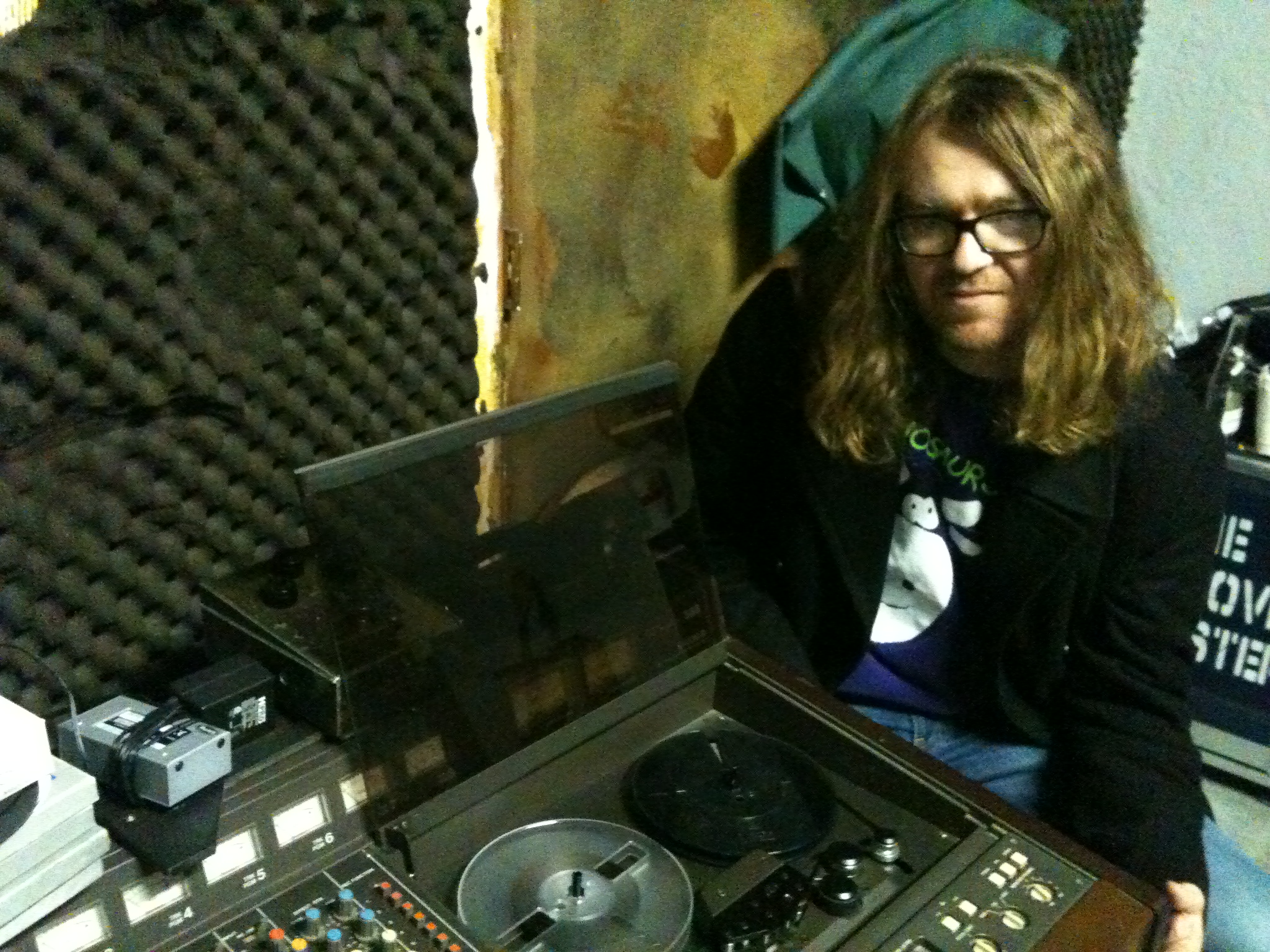
Luke Giffen and his reel-to-reel tape machine.
I also interviewed Fresno musician Luke Giffen for the story. His former band, The Sleepover Disaster, released its last album on CD via the now-defunct indie label Devil In The Woods. His current band, The Quiet Americans, released its debut EP, “Medicine,” on cassette via coattrack. I reviewed the EP back in May for Fresno Famous, and I had played tracks from it on my old Evening Eclectic show. But I listened on repeat to “Medicine” on cassette tape in my car during the final week I spent working on this story, and I have to say that I absolutely fell in love with it. The warble and the wobble really intensified as I studied the record on tape, as opposed to the digital versions of the songs I had first gotten to know. Listening to “Medicine” on tape, quite simply, made it better. And that surprised me.

My little home recording experiment.

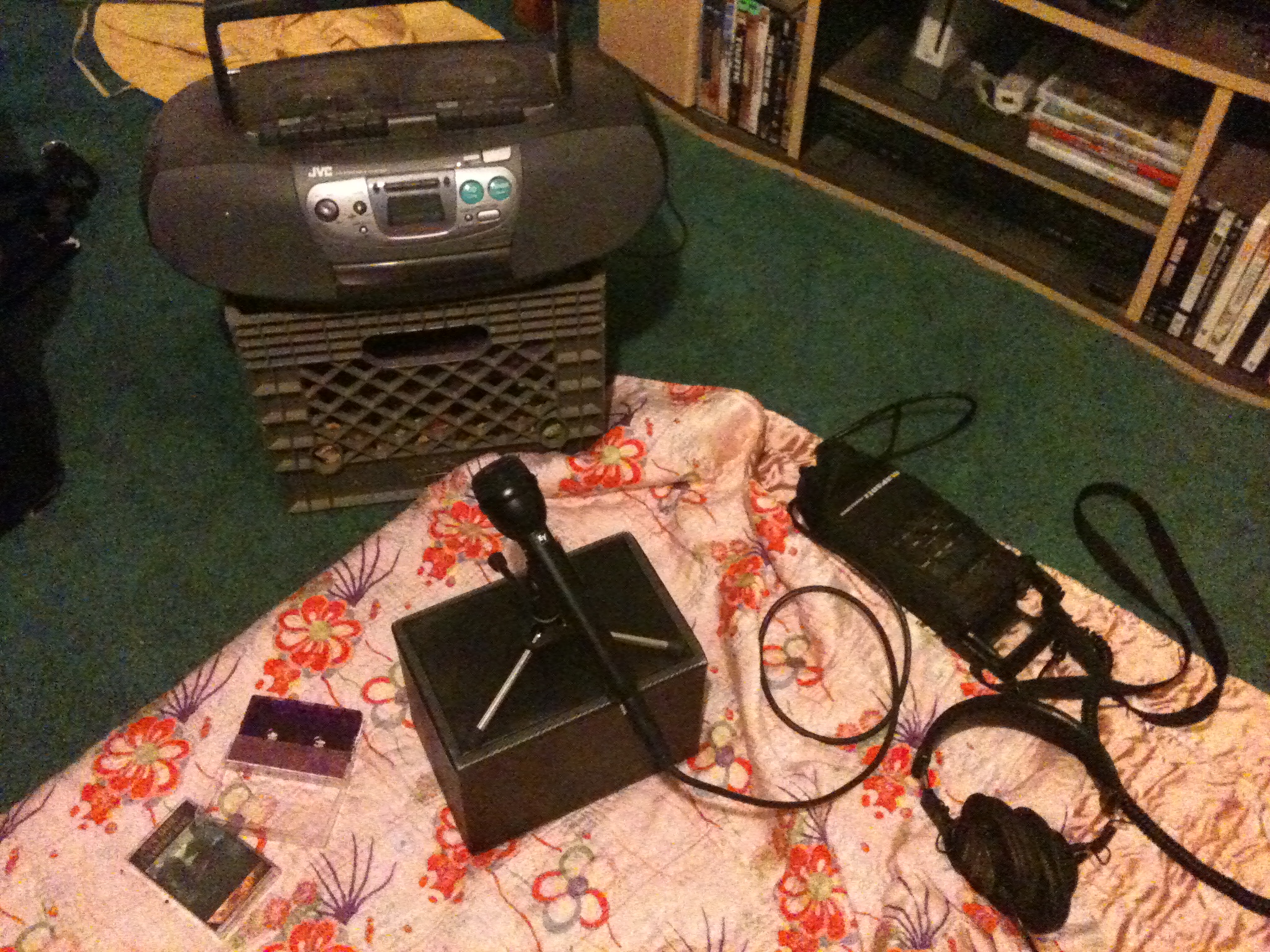
The experience of hearing and appreciating “Medicine” in a new way in my car gave me an idea. For the story, instead of using high-quality .WAV files for the music in the piece by The Quiet Americans, Achievement House, and the Fay Wrays, I went old-school instead. I first dusted off my old JVC boombox, which was buried under a pile of fabric in my wife’s craft room. I readied the cassette tape versions of the three albums I was using and carefully fast-forwarded to cue up the songs I wanted. I hooked up my Marantz 660 digital recorder and ElectroVoice RE-50/B omni microphone to capture the sound. And then I played the music out of the boombox, muddy distortion and all, right into the Marantz. The results, as you’ll hear, sounded great.

Here’s the link to the final radio story. As a bonus, here’s a link to Giffen’s beautifully affecting homemade video for The Quiet Americans song “Be Alone.”

Big-Kid Playtime Party in the Park

This slideshow requires JavaScript.

On Oct. 27, my good friend Teresa Flores and I co-hosted Big-Kid Playtime Party in the Park, a flash mob event at Cary Park in east-central Fresno. We encouraged participants to re-enact the childhood playtime of their youth in an experiment to see what would happen when we gave “adults” a chance to escape their “adult lives” by making time to be a kid. Activities included tossing around a frisbee and a nerf football, scaling playground equipment, competing in freeze-tag and ultimate frisbee, and running around a lot in general. Counting me and Teresa, eleven people dressed in big-kid clothes came out to play for an hour on a sunny Thursday afternoon for some loosely choreographed playtime.

The playtime flash mob was originally an idea for my Photo 17 black-and-white film class at Fresno City College, in response to an action photography assignment. But I quickly realized that the action during the Big-Kid Playtime Party in the Park was actually way too fast for me to document while also taking accurate exposure notes, framing shots for good lighting, and semi-directing all at the same time. So I ditched the film idea, grabbed my digital camera instead, and made photographs (mostly on shutter-priority settings) for the blog. Teresa, who is one of my favorite mixed-media artists, also shot video of the playtime party for a future post on her blog. She’ll finish her video soon.

While editing my photos for the slideshow, I noticed something: Participants had such huge smiles on their faces during playtime! The best thing I discovered was that people just need a little nudge to remind them how much fun it is to get outside and play. It was a terrific, endearing surprise, and I heard from more than one participant that another Big-Kid Playtime Party in the Park needed to happen in the future.

Late in the designated playtime, a chaotic and amoeba-like contest of ultimate frisbee lingered as the sun went down. I had finished shooting my two rolls of black-and-white film and I had taken more than 150 digital shots. Teresa had finished shooting video footage. She and I stood to the side and watched everyone continue to scramble around in the grass long after we, as directors, had stepped aside. The big kids forgot why they were there, lost in laughter, enjoying their game.

Assignment: children’s coloring book cover

Two penguins are better than one, even if one's drawn a bit wonky.

Hey, man. Let me ask you something. If somebody draws something and then you draw the exact same thing right on top of it, without going outside the original designated art. What do you call that? … I don’t know, man. TRACING?

For our fifth assignment in my GRC 41 class, the instructor asked us to create a book cover for a children’s coloring book. But there was one catch: We had to use the pen tool in Adobe Illustrator CS4, one of the hardest tools in the Adobe Creative Suite. From there, we could choose one of three provided coloring book covers to try and replicate. I picked the “Gigancolor” cover of a penguin in his winter garb, surrounded by snowflakes. I loved that little penguin at first sight!

The instructor showed us how to insert the model book cover into the Illustrator document as a layer, and then hide it behind the main working layer. That way, we could basically trace each piece of the existing cover with the pen tool, one tiny curve at a time. The pen tool is a maddening little gadget, especially for someone like me who doesn’t have much experience with Illustrator. But I picked up the basics quickly enough to knock out my new penguin friend as best I could. The replica is not perfect, of course, but I’m proud of the final result–especially considering it was my first ever time using the pen tool. Pictured above, my version is on the left and the original is on the right.

And I’m totally fine that I traced it. No need to put a pen in anyone’s thorax or anything.

Radio story: Hmong American writers

Fresno poet Soul Vang is believed to be the first Hmong American to earn an MFA in poetry.

My first freelance radio story for The California Report aired on Friday, Oct. 21. I reported on the Fresno-based Hmong American Writers’ Circle and their groundbreaking new collection of literature, How Do I Begin? It was a great feeling to hear myself on the radio telling a good story, and the subject matter had a lot to do with my feeling of success.

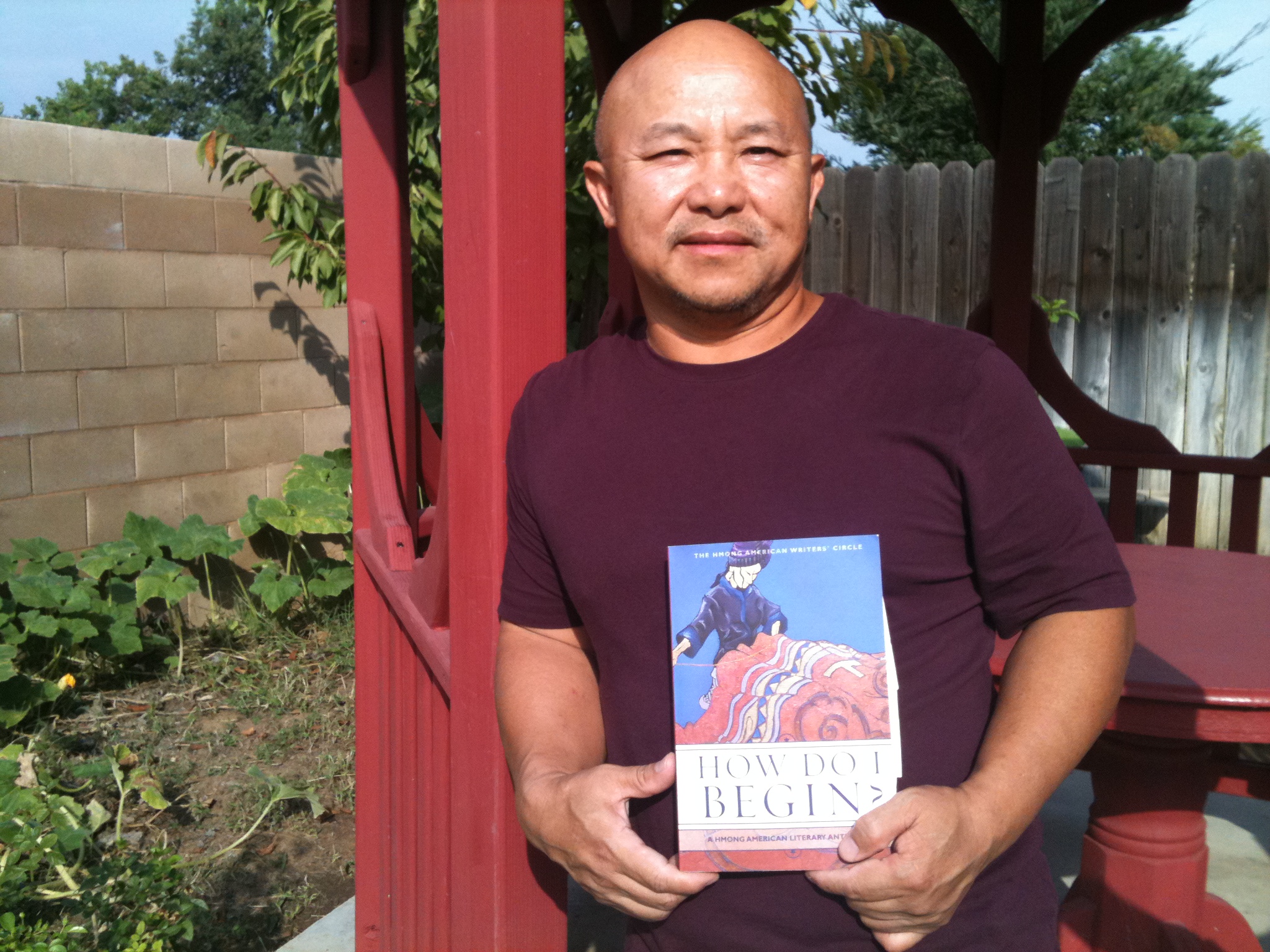
I was lucky to have long interview conversations with two HAWC members whose writing I’ve long admired: Soul Choj Vang and Burlee Vang. We talked about the book, we talked about writing, and we talked about the immigrant experience in America, which is captured so vividly throughout the book. I invited both Soul and Burlee to come into The California Report’s bureau office not only for their main interviews, but also to perform some of their work. Excerpts from Soul’s poem “Here I Am,” which inspired the anthology’s title, and Burlee’s poem “Eating Without the Poet” made it into the finished story, and I was so glad that listeners got to hear snippets of these two remarkable writers’ work in their own voices.

Burlee Vang, who teaches at Fresno City College, founded the Hmong American Writers' Circle in 2004.

In the process of reporting, I was most humbled by my time spent in Soul’s home and in Burlee’s classroom. On one day, Soul invited me into his home to observe him with his family. He has two sons with special needs who demanded a lot of his attention. He also has the hustle and bustle of a house with three generations of family under one roof, each member filling his or her duties in a graceful but clockwork fashion. On another day, Burlee invited me into his classroom at Fresno City College to observe him with his English 1A students. He has a talkative bunch of beginning writers who demanded a lot of his attention as well. He also has the chaos of a first-year composition course to orchestrate, each student workshopping his or her paper in a sprawling but organized fashion. Unfortunately, none of the sound I gathered at either location ended up making it into the final story. But my time spent with Soul and Burlee in their respective worlds was truly a gift, and it reminded me that reporters are wise to never take that kind of trust for granted.

Here’s the link to the final radio story. Please listen to the audio version first, before you read the extended text version that I wrote for the website. Then, at the bottom of the text version, listen to the full poems by Soul and Burlee.

Assignment: promotional posters

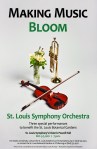
For our fourth assignment in my GRC 41 class, the instructor asked us to design a series of promotional posters for three very different events– a hardware convention, a symphony orchestra benefit for a botanical garden, and a student film festival.

The assignment said that the images should be dominant in the composition and communicate clearly by themselves. The text needed to be supportive both conceptually and compositionally. And although the poster subjects were very different, each 11×17 poster needed to family together as if they were displayed all at once. The assignment was to be composed primarily in Adobe Photoshop, with some typographical help from Illustrator and/or InDesign if we chose to use it.

I spent the entire first week researching the three events and conceptualizing the audience and purpose of each poster. I also brainstormed simple, iconic images for hardware and retailing, orchestras and botanical gardens, and movies and film festivals.

I decided that my unifying element would be a simple studio photograph composed and made specifically for each poster. But there was one problem, though: I don’t know anything about studio lighting and photography! So in the second week of the project, I enlisted the help of my friend Craig Kohlruss, a longtime photojournalist at The Fresno Bee where I used to work. Craig very graciously volunteered his time to compose, light, and make the photos. Craig also arranged for the photos to be taken at the downtown Fresno studio of Ryan C. Jones, a commercial photographer with tons of cred among Fresno creatives, so I could make a new connection.

Having a chance to work with Craig inside Ryan’s studio, and then take the two of them out to lunch afterward to pick their brains about photography, was truly a gift. I especially appreciated their encouragement in pursuing photography not only as “art” but as a real job that demanded and deserved real compensation. I loved hearing their stories about their own struggles to get started in the business.

The studio photos would not have been possible without the help of several good friends who loaned me their props. Thanks especially to Tracy Stuntz, my wife, for the flower arrangement; to Ana Marin, an investigator for the USDA, for the trumpet; to Reaz Mahmood, a multimedia artist and journalism instructor, for the violin; and to Joy Quigley, a filmmaker and the president of Fresno Filmworks, for all of the film items.

Finally, back in the graphics lab, I worked last week to typeset the content and work the typography. Using InDesign, I matched the font and color choices to what the organizations had on their respective websites, and then I converted the text to outlines and placed everything into Photoshop, where I did the final scaling and design. I think the results are clean and simple, especially since I don’t yet know a lot about Photoshop.

Above all else, this assignment taught me that asking people for help can yield unexpected and inspiring results. The concept of the posters was mine from start to finish, but without a lot of help from my friends– especially from Craig behind the lights and the camera– I would not have been able to execute that vision.